
Figuring out what you can expect to pay for solar panel installation in Florida is the first, most important step toward energy independence and real, long-term savings. The good news? A standard solar system here typically runs between $11,000 and $18,000 before any incentives kick in, and our price per watt is quite a bit lower than in many other states. That competitive pricing makes the switch to solar energy a very smart financial move for a lot of Florida homeowners.
Your Quick Guide to Florida Solar Panel Costs
Florida has become a true hotspot for solar energy, which has created a super competitive market that directly benefits you, the homeowner. Unlike notoriously expensive areas like Southern California, the Sunshine State offers a much more accessible entry point for anyone looking to harness the power of solar. The state is packed with installers, especially in hubs like Tampa and Orlando, which helps drive prices down and keep quality high for homeowners seeking energy savings.
This means that for Florida homeowners, the dream of generating your own clean energy is more attainable than ever. That initial investment in solar unlocks decades of savings on electricity bills, giving you a stable, predictable alternative to the rollercoaster of utility rates. Let’s start by understanding the baseline costs for this energy solution.
Breaking Down the Numbers
The cost of a solar panel system is usually measured in dollars per watt, and in Florida, that number is impressively low. Recent data confirms that Florida is one of the most competitive solar markets in the country. The average cost to install a 5 kilowatt (kW) solar panel system is right around $10,926 before incentives. That works out to roughly $2.19 per watt, which makes our solar installation costs look pretty great compared to the national average. You can dig into more of these cost insights over at EnergySage.com.
That per-watt price isn’t just for the panels—it’s an all-in figure that includes everything you need for a complete, working solar energy system:
- Solar Panels: The heart of your system, capturing sunlight to generate all that power and deliver savings.
- Inverters: These clever devices convert the direct current (DC) energy from your panels into the alternating current (AC) your home actually uses.
- Racking and Mounting: The tough, durable hardware that securely fastens the solar panels to your roof.
- Labor and Permitting: All the costs for professional installation, inspections, and getting the green light from your local authorities in places like Tampa or Orlando.
Estimated System Costs for Homeowners
To give you a clearer picture, let’s look at some common system sizes and what they might cost before any tax credits or rebates. The right size for your home really depends on your average energy use, which you can find right on your monthly utility bill. A larger home in Tampa, for example, will likely need a bigger solar system than a smaller condo in Orlando to achieve maximum savings.
Here’s a quick reference table to give you a ballpark idea of what you might be looking at.
Estimated Florida Solar System Costs Before Incentives
| System Size (kW) | Average Cost Per Watt | Estimated Total Cost (Pre-Incentive) | Ideal for Home Size |
| 5 kW | $2.19 | $10,950 | 1,000 – 1,500 sq. ft. |
| 7 kW | $2.15 | $15,050 | 1,500 – 2,000 sq. ft. |
| 10 kW | $2.10 | $21,000 | 2,000 – 3,000 sq. ft. |
| 12 kW | $2.05 | $24,600 | 3,000+ sq. ft. |
For most homeowners, the goal is to offset as much of the electricity bill as possible. A properly sized solar system can wipe out a huge chunk—or even all—of your monthly energy costs, which adds up to massive long-term savings.
Ultimately, these initial figures give you a solid starting point. As we’ll get into next, all sorts of things—from your specific roof to powerful tax incentives—will shape your final cost, making your solar investment even more rewarding.
What’s Really Driving Your Solar System’s Price Tag?
When you start getting solar quotes in Florida, you’ll quickly notice they’re all over the map. Why is one company’s price so different from another? It’s because a solar installation isn’t an off-the-shelf product. It’s a custom job, like building a car from the ground up—your final price depends on the engine you pick, the features you add, and how complex the build is.
Your solar system is no different. The final number you see is a mix of the actual hardware, the unique quirks of your home, and the “soft costs” required to get the project done right. Once you understand what goes into it, you can see exactly what homeowners are paying for.
The Hardware: What Your System is Built On
The most straightforward costs are the physical parts of your solar system. And just like any other major home project, you get what you pay for. Better quality often costs more upfront but pays you back with higher efficiency and more savings over the long haul.
Here’s the main gear that shapes your final price:
- Solar Panels: The panels themselves have a huge price range. Premium, high-efficiency panels cost more but crank out more power in less space—perfect if your roof is on the smaller side. Standard solar panels are more budget-friendly and work great on big, open roofs with tons of sun.
- Inverters: This is the brain of the whole operation. A standard string inverter is the most common, cost-effective option. But if parts of your roof get shaded during the day, upgrading to microinverters or power optimizers, while more expensive, will squeeze a lot more solar energy out of your system.
- Battery Storage: This is a big one. Tacking on a solar battery will definitely bump up your initial investment. But for any homeowners who want to keep the lights on during a power outage and be truly energy independent, a battery is a must-have for peace of mind.
Choosing the right hardware is always a balancing act between your budget, what you want to achieve, and your roof’s layout. A simple, south-facing roof in Orlando might do just fine with standard panels. But a home in Tampa with a few trees casting shadows could get a massive performance boost from microinverters. This flexibility in solar technology ensures great savings for every situation.
Your Home’s Unique Footprint
Putting the equipment aside, your house itself has a huge say in the final cost. No two roofs are the same, and those little differences directly affect the time, labor, and materials needed for a solid solar installation.
For example, a super steep roof with lots of angles and vents is a much tougher job than a simple, low-pitch roof. It takes more specialized labor and different mounting gear. The age of your roof is also a big factor. If it’s getting old, any good solar installer will tell you to replace it before putting panels on top. It adds to the project cost, sure, but it saves you from a massive headache later.
Your main electrical panel might need an upgrade, too. Older homes often have panels that can’t handle the extra energy coming in from the sun, so a swap is necessary to keep things safe and running smoothly.
Cracking the Code on “Soft Costs”
Here’s something that surprises a lot of homeowners: a huge chunk of your total solar cost—sometimes over 60%—is tied up in “soft costs.” These are all the essential, non-hardware expenses that make a project happen. While homeowners in places like Southern California often get hit with higher soft costs, Florida’s competitive solar market is competitive enough to keep them in check, leading to better savings.
These are the costs working behind the scenes:
- System Design and Engineering: This is where experts map out a custom blueprint for your solar array, making sure it’s positioned perfectly to capture the most sun based on your home’s specific orientation and energy needs.
- Permitting and Inspection Fees: Every city, from Tampa to Orlando, has its own rules and fees for approving a solar project. Your installer is the one who has to navigate all that red tape.
- Labor and Installation: This pays for the skilled crew that physically gets on your roof to install the solar panels, run the wiring, and make sure everything is rock-solid and up to code.
- Operational Costs: This covers the solar company’s cost of doing business—things like customer support, project management, and marketing that lead to a smooth process for you.
Comparing Solar Costs in Tampa and Orlando
Florida might be a fantastic state for solar, but don’t assume the price you pay in one city will be the same in another. It’s a lot like real estate—the exact same house costs more in a hot neighborhood. When it comes to solar, your “neighborhood” is defined by local labor costs, the number of installers fighting for your business, and the specific rules of your utility company.
Two of Florida’s biggest solar hubs, Tampa and Orlando, are a perfect case study. They’re only about 85 miles apart, but they operate in completely different local economies. These differences can ripple through everything from your upfront investment to your long-term savings, which is why a city-by-city breakdown is so important for homeowners.
The Tampa Solar Market
Tampa’s solar scene is mature and highly competitive. With a ton of established installers in the area, homeowners often find better pricing simply because companies have to work harder to win your project. That competition helps drive down labor and installation costs, often leading to a slightly lower price per watt than you might find elsewhere for solar energy.
For most homeowners in Tampa, the utility is Tampa Electric (TECO). TECO has its own set of rules for connecting your solar system to their grid and for their net metering program. The process is straightforward, but it’s critical to have a local installer who knows TECO’s playbook inside and out. It’s the key to getting your system turned on without unnecessary delays.
The Orlando Solar Market
Over in Orlando, the solar market is a little different. It’s growing like crazy, but the competitive landscape isn’t quite the same as Tampa’s. The area is primarily served by Duke Energy and the Orlando Utilities Commission (OUC). Labor rates can be a bit more variable depending on seasonal demand, and the permitting process in Orange County can add its own wrinkles to the final cost.
Duke Energy, for example, has its own specific requirements for interconnection that are distinct from TECO’s. This is precisely why a generic, one-size-fits-all solar quote just doesn’t fly. The unique engineering drawings and paperwork required for a Duke Energy submission can bump up the “soft costs” we talked about earlier, which can absolutely influence the final price for an Orlando homeowner seeking energy savings.
The big takeaway here is that local details matter—a lot. Your utility provider, the city permitting office, and the intensity of local competition directly shape your final solar investment and how much you’ll save.
A Tale of Two Homeowners
Let’s make this real. Picture two identical 2,000-square-foot homes, one in a Tampa suburb and the other in Orlando. Both families get a $180 power bill every month and need a 7 kW solar system to wipe it out and maximize their savings.
- Tampa Homeowner (TECO): Thanks to the fierce local competition, they get a solar quote for $2.15 per watt. Their total cost before any incentives is $15,050.
- Orlando Homeowner (Duke Energy): Facing a slightly different market, their quote comes in at $2.20 per watt. Their total solar cost lands at $15,400.
It’s not a massive difference at first glance, but it perfectly illustrates how your address affects the price. Over the 25-year life of their solar panels, both homeowners are going to save tens of thousands of dollars on energy, but they start from two slightly different places. Understanding these nuances is the first step, and our guide on how to get solar panels dives deeper into the quoting process. This kind of local knowledge empowers you to make a confident decision and sets you up for the best possible financial outcome.
Maximizing Your Savings with Florida Solar Incentives
Let’s be honest: the initial price tag on a solar system is just the starting point. For Florida homeowners, the real magic happens when you start layering in the powerful financial incentives designed to bring that number way, way down.
Think of these as huge, built-in discounts from both the federal government and the state. They’re not just small perks; they’re game-changing financial tools that make going solar one of the smartest home investments you can make for energy savings.
The Federal Residential Clean Energy Credit
The biggest player here is the federal Residential Clean Energy Credit, often just called the solar tax credit. This isn’t a simple deduction—it’s a dollar-for-dollar credit that directly reduces what you owe in federal income taxes.
Right now, homeowners can claim 30% of the total cost of your solar system. That includes everything: the panels, inverters, labor, and even battery storage.
So, if your total system cost in Tampa comes out to $21,000, the federal credit chops off $6,300 from your tax bill. It’s that simple and a huge boost for solar savings.
This is what makes solar accessible for so many people. It’s like getting a 30% off coupon from the government for upgrading your home’s energy. And if you don’t owe enough in taxes one year to use the whole credit, you can just roll the rest over to the next year.
This credit alone turns a major home upgrade into a much more manageable and rewarding investment. But it’s only the first layer of savings for solar.
Florida’s Homeowner-Friendly Tax Exemptions
While the federal credit gets most of the limelight, Florida throws in its own fantastic solar incentives that stack right on top. The Sunshine State directly tackles two big financial hurdles for homeowners: sales tax and property tax.
Here’s how Florida helps you save even more:
- Solar and Energy Storage Equipment Sales Tax Exemption: When you buy your solar system, you won’t pay a single cent in state sales tax. On that $21,000 system, a 6% sales tax would normally add $1,260 to your bill. Florida just wipes that cost away completely.
- Property Tax Exemption for Renewable Energy Property: Usually, when you make a major home improvement that increases your property value, your property taxes go up too. A solar system can boost your home’s value by over 4%, but Florida makes a special exception. State law prevents your property assessment from rising because you added solar energy equipment.
These state-level rules are a huge deal. You get all the upside of a more valuable home without the sting of a higher tax bill—a massive advantage over homeowners in places like Southern California, where the property tax rules aren’t nearly as friendly.
For a deeper dive, check out our complete guide on solar power incentives in Florida. Combining these state benefits with the huge federal tax credit is the key to unlocking the best possible return on your solar investment.
Calculating Your Long-Term Solar Savings and ROI
The best way to think about a solar system isn’t as a home expense, but as a powerful financial asset that starts paying you back from day one. For Florida homeowners, running the numbers on your payback period and return on investment (ROI) makes it obvious just how quickly solar starts working in your favor.
When you account for your final cost after incentives, your expected monthly savings, and the reality of rising utility rates in Florida, the picture becomes incredibly clear. Unlike homeowners in places like Southern California who often see higher upfront costs, the competitive pricing in cities like Tampa and Orlando gives you a huge head start on seeing a positive return on your solar energy investment.
What Is a Solar Payback Period?
Your solar payback period is simply how long it takes for your system’s energy savings to completely cover its initial cost. Think of it as your breakeven point—the day your investment has officially paid for itself. From that point on, every bit of energy your solar panels produce is pure savings.
A few key things determine how fast you get there:
- Your Net System Cost: This is the total price after you subtract the 30% federal tax credit and any other local perks. The lower your net solar cost, the shorter the payback.
- Your Electricity Rates: The more you’re paying your utility, the more you save each month with solar. This dramatically speeds up your ROI. As rates from companies in Tampa and Orlando keep climbing, your energy savings only get bigger.
- Your System’s Production: A well-designed solar system, positioned to catch maximum sun, will pump out more power. More power means bigger savings and a quicker payback.
Crunching the Numbers for Florida Homeowners
Florida’s endless sunshine and great solar incentives create the perfect storm for a fast return on your investment. For most solar installations in Florida, the payback period for homeowners lands somewhere between 6 to 11 years, depending on your exact system and where you live.
Over the 25-year life of the panels, it’s not uncommon for Florida homeowners to see net savings climb well over $80,000 just from wiping out their electricity bills. You can see more real-world examples from the experts at Palmetto.com.
This graphic shows you exactly how the big incentives cut down your upfront cost and get you to profitability faster.
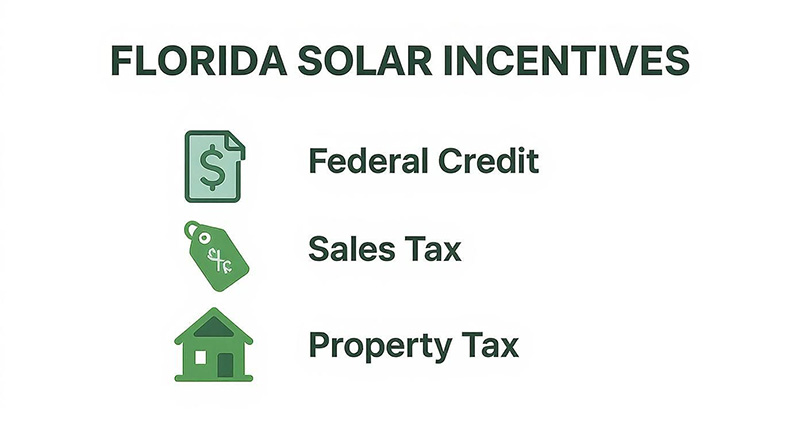
These incentives—the federal credit, sales tax exemption, and property tax break—all stack up to make your solar investment far more affordable and accelerate your ROI.
The real magic of solar is turning a monthly liability—your electric bill—into an asset that builds value. Once your system is paid off, you’re essentially getting free energy for the rest of its 25+ year lifespan. That’s decades of predictable savings.
Sample 25-Year Solar ROI Scenario in Florida
To see how this plays out over the long haul, let’s look at a hypothetical example. This table breaks down the cumulative savings and payback timeline for a typical Florida solar installation, showing how the investment pays for itself and then starts generating pure profit.
| Year | Annual Electricity Savings | Cumulative Savings | Remaining Investment |
| 1 | $2,400 | $2,400 | $15,600 |
| 3 | $2,546 | $7,489 | $10,511 |
| 5 | $2,702 | $12,963 | $5,037 |
| 7 | $2,868 | $18,854 | ($854) |
| 10 | $3,124 | $28,788 | ($10,788) |
| 15 | $3,616 | $48,011 | ($30,011) |
| 20 | $4,185 | $71,460 | ($53,460) |
| 25 | $4,845 | $99,997 | ($81,997) |
As you can see, the solar system breaks even around Year 7. After that, the savings pile up quickly, turning into nearly $100,000 in positive returns over the life of the system.
The Lifetime Value of Your Solar Investment
Looking past the payback period, the true financial win is the total return you get over the system’s entire life. This is where solar really proves its worth. A solar energy system is one of the only home improvements that not only pays for itself but keeps generating positive cash flow for decades.
To get a precise estimate for your own home, you can use our solar payback period calculator to model your potential savings. This tool helps you see how the investment performs over time, shifting the conversation from a one-time cost to a lasting financial benefit that boosts your property value and locks in your energy future.
Your Top Solar Questions Answered
Even after crunching the numbers, most homeowners have a few lingering questions before they’re ready to make the switch. It’s completely normal. Let’s tackle the big ones so you can feel confident about your decision to go solar.
How Do Solar Panels Handle Florida Hurricanes?
This is the question I hear most often from homeowners, and for good reason. The short answer: modern solar panels are built like tanks. They’re not just sitting on your roof; they’re engineered to meet Florida’s incredibly strict building codes for hurricane-prone areas.
That means they are rigorously tested and required to withstand wind speeds of 175 mph or more. The solar panels are bolted directly into your roof’s structural trusses, essentially becoming an integrated, reinforced part of your home. They’re ready for whatever storm season throws at them.
Will Net Metering in Florida Completely Eliminate My Bill?
Net metering is a fantastic deal for homeowners. It’s the mechanism that credits you for all the extra solar energy your panels produce and send back to the grid. While it can slash your energy charges down to zero, you’ll almost always have a small monthly bill.
Think of it as a basic connection fee. Utilities like TECO in Tampa or Duke in Orlando charge it to maintain the grid infrastructure. So, while your energy usage cost can be wiped out, that small fixed charge usually remains. The goal is to get it as close to zero as possible for maximum savings.
Key Takeaway: A properly sized solar system, paired with Florida’s net metering rules, gives homeowners a level of control over their energy costs that’s simply impossible when you’re just “renting” power from the utility company month after month.
Is Adding a Battery Really Worth the Extra Cost?
For a growing number of Floridians, the answer is an emphatic “yes.” A standard grid-tied solar system is great for saving money, but a battery buys you something more valuable: energy independence.
When the grid goes down during a storm—and we all know it happens—a solar battery keeps your lights on, your fridge cold, and your essentials running without a hiccup. It also lets you store the free, clean energy you generate during the day and use it at night, pushing your reliance on the utility company even lower.
How Does Florida’s Solar Market Compare to, Say, Southern California?
You might be surprised to hear that Florida often has a leg up on Southern California when it comes to affordability for homeowners. The market here is incredibly competitive, especially in hubs like Tampa and Orlando.
This competition drives down the overall solar panel installation cost florida. When you combine those lower upfront costs with our powerful sunshine and strong state incentives, it means homeowners in the Sunshine State can often see a faster payback period and more significant long-term savings from their solar energy system.
At Current Home, our mission is to make going solar straightforward and affordable for every Florida homeowner. Our team lives and breathes this stuff, and we’re here to walk you through every question you have. We’ll design a system that fits your home, your budget, and your goals perfectly.
Ready to stop renting your power and start owning it?
Get a free, no-pressure quote from our team today at https://currenthome.com.